


There’s a version of success in brand strategy that looks identical to failure until about three years later. You build something so good, so category-defining, that everyone copies it. Then you spend the rest of your life explaining to clients why you were the original, not just the loudest.
Aperol is finding this out right now, in real time, while trying to work out what to do about it.
I say this as someone who has put “own the category” in more decks than I can count. It’s the holy grail line. Be the definitional brand, the one people picture when they picture the thing. And it works, right up until it doesn’t. Right up until the category you built gets bigger than you, and every competitor who couldn’t be bothered to do the hard work gets to walk through the door you paid to open.
For most of its hundred-year history, Aperol was a regional Italian aperitif nobody outside Northern Italy had strong feelings about. A family business, no real ambition to leave the region. Then Campari Group bought it in 2003, brought serious distribution and marketing muscle to a product that had neither, and by 2017 was pouring real money into scaling it in the US. The bet paid off in numbers that are hard to argue with: from around 60 million Aperol Spritzes served a year, two decades ago, to roughly 1.5 billion served globally today. Aperol is now Campari’s biggest brand, about a quarter of the group’s sales, close to $900 million in 2025.
That’s a category built from scratch, on purpose, at scale. And it’s worth sitting with how they actually did it, because most of the industry still talks about “building a category” like it’s a vibe you generate rather than a set of specific, repeatable decisions.

Simple is a strategy, not a shortcut
The first thing Campari did was make the drink boringly, aggressively consistent. Three parts prosecco, two parts Aperol, one splash of soda, poured in that exact order so the colour stays right. They gave it an acronym so bartenders wouldn’t forget it. Then they trained the bartenders directly, for free, through the Campari Academy: over 13,000 trade staff in the US alone in 2025, tens of thousands more touched through live and digital sessions.
That’s the part people skip when they tell the Aperol story as a marketing story. It was making the drink so fast and cheap to pour that the bar itself had every incentive to sell it. Fifteen seconds to build, no shaker, no extra step, and priced low enough that a bar can still land the finished cocktail under twenty dollars in New York and make margin. What they did so well, was market to the person standing behind the bar who decides what gets recommended when someone says “surprise me.”
I think most brands get this backwards. They spend the budget on the person holding the glass and nothing on the person pouring it, then wonder why the product doesn’t stick once the campaign ends. The intermediary is often the actual channel. Aperol treated the bartender as the customer and the drinker as the beneficiary.
You can’t trademark a category
When you develop a category, you can’t trademark it. You will inevitably create the competition that eats you.
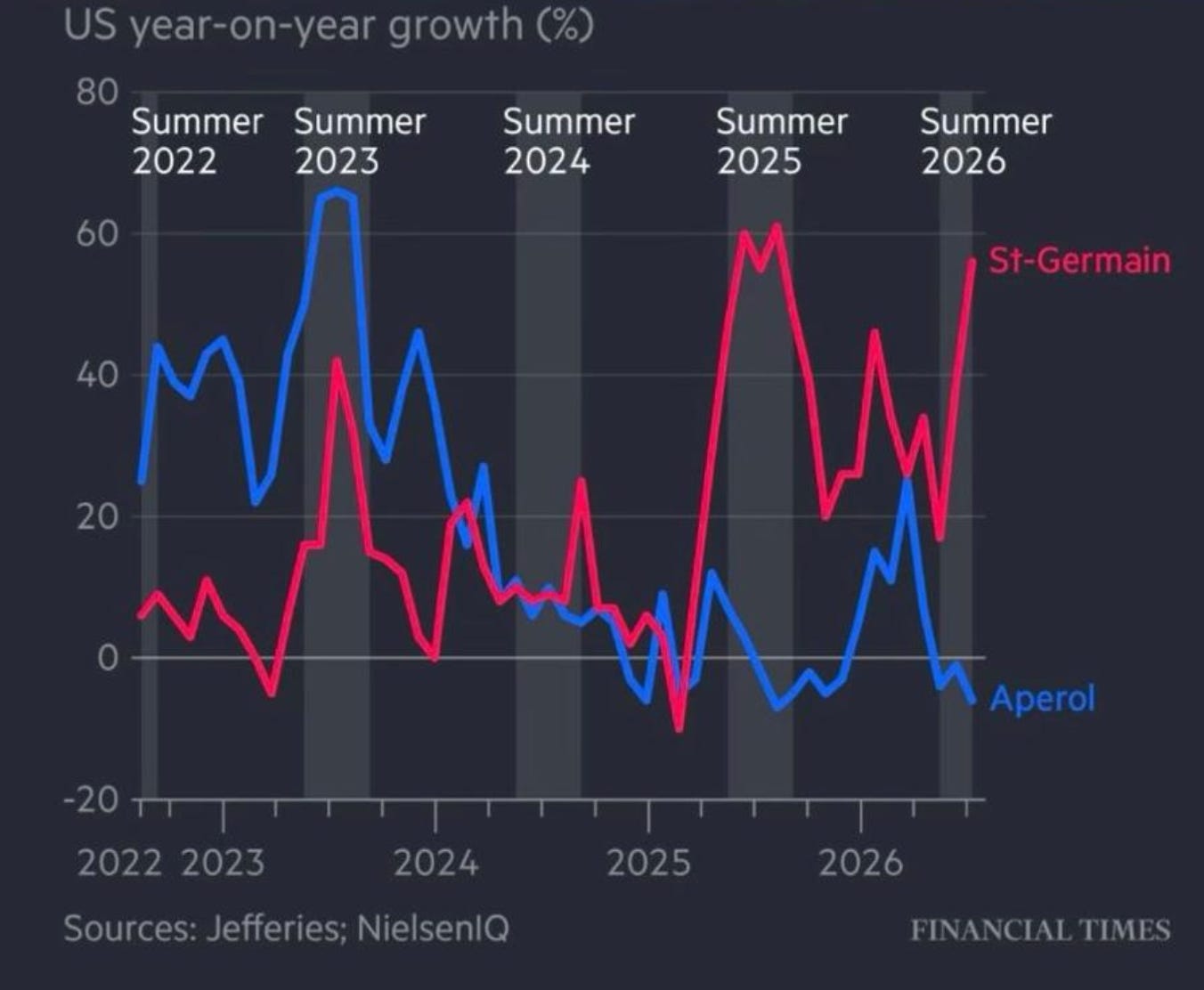
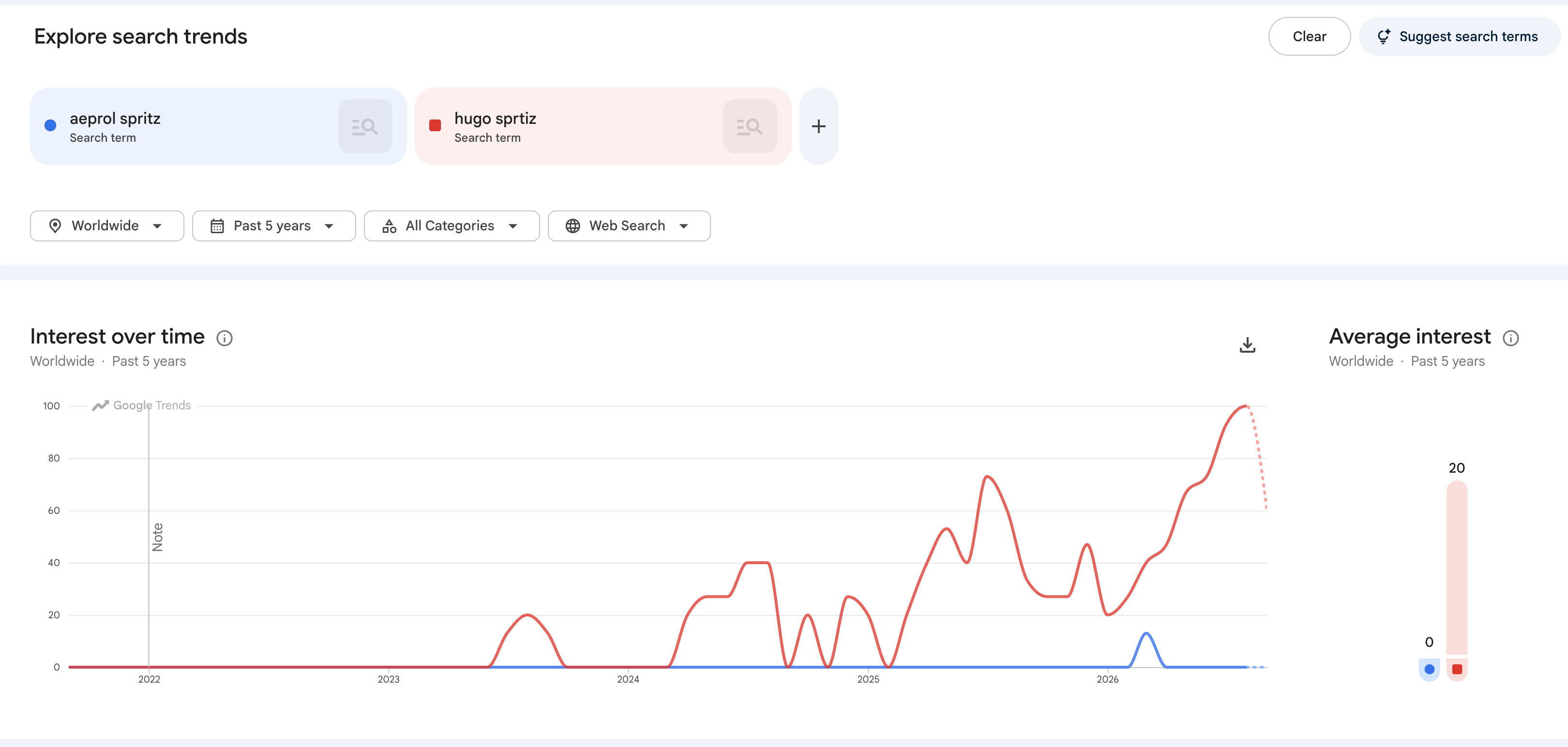
Global spritz consumption went from under 2.5 billion servings in 2019 to nearly 4 billion in 2024. That growth isn’t all Aperol. It’s Hugo Spritz, backed now by Bacardi putting real money behind St-Germain. It’s Select, it’s Limoncello spritz, it’s whatever’s on the specials board at your local on a Friday. One bar consultant put it at roughly one Hugo request for every five Aperol requests now, which sounds small until you remember Hugo barely existed as a mainstream order three years ago.
Aperol still wins on volume by a wide margin, something like twenty times the case volume of its nearest challengers. But that’s not really the point. The point is that every dollar Campari spent teaching Americans what a spritz is, how it’s meant to taste, when to order one, also taught them the category, not just the brand. You can’t run that education campaign and keep the graduates. Some of them are always going to go try the other thing on the menu, because you’re the one who told them spritz culture exists in the first place.
This is the uncomfortable version of category creation. The more successfully you evangelise a category, the more you’re subsidising your own competitors’ customer acquisition. Nobody puts that in the deck.
You can borrow culture, you can’t keep it
The third thing Aperol got right was timing it couldn’t fully take credit for. Drinking habits were already shifting toward lower alcohol, especially post-pandemic, especially with a younger cohort drinking less overall. A low-ABV, brightly coloured, photogenic drink was a near-perfect fit for a shift that was already underway before Campari leaned into it. Dinner reservations moved earlier, aperitivo-hour habits took hold, and Aperol was positioned exactly where the culture was already heading.
Then pop culture did the rest for free. Five appearances in a single season of The White Lotus and mentions of the brand jumped nearly 25% on social media in the same window. The colour alone, that specific shade of orange in that specific glass, became something people could recognise from across a rooftop bar or a scrolling feed without a logo in sight. That’s genuinely rare and genuinely valuable.
But borrowed relevance is borrowed. The same generational shift toward lower ABV drinking that lifted Aperol lifts anything else positioned the same way. Campari built a lot of that demand on purpose too, showing up at Coachella and Lollapalooza with a captive, novelty-seeking audience and handing out close to 100,000 free samples at events this year alone, on the theory that bitter is an acquired taste and you need someone to hand you the first one. That’s smart. It’s also a playbook, not a moat, and Hugo Spritz’s backers at Bacardi clearly read the same one. Being visually iconic gets you noticed. It doesn’t get you owned. Those are different jobs, and only one of them is defensible.
The part nobody’s resolved yet
Campari’s response to all this is to hedge everywhere at once. They’re expanding the portfolio rather than defending one product: Crodino as the non-alcoholic option, Sarti as a sweeter alternative, new formats like cans and Aperol on tap to catch drinking occasions the original recipe can’t reach. The logic, as one person in the piece put it, is that if a customer is going to wander off Aperol eventually, better they wander to another Campari product than to someone else’s.
That’s a sound defensive move. It’s also a real bet against the thing that made Aperol work in the first place. Part of the appeal, arguably most of it, was the ritual: the specific pour order, the specific glass, the specific garnish, the theatre of watching someone build it in front of you. A can doesn’t have a ritual. Neither does a tap. One of the operators interviewed said it plainly, that these formats take away from the core idea of having a beautiful thing built in your hands, and that whether it damages the brand long-term is genuinely still unknown.
I don’t think that’s resolved and I don’t think Campari thinks it’s resolved either. That’s what the hedging tells you. When a company launches four different versions of itself simultaneously, it’s not confidence. It’s a company that suspects the original formula might not survive its own success and wants to be covered either way.
So is there a way to build a category without also building the on-ramp for everyone who wants to compete in it? I’m not sure there is. Maybe the honest answer is you don’t try to own a category at all, you just try to stay the automatic answer inside a category you know you’ll eventually share, which is a much longer and much less satisfying game than the one most brand strategy decks are actually built to sell. Maybe the ritual and the convenience formats can coexist without cannibalising each other, and maybe they can’t, and Campari genuinely won’t know which for another few years.
What I do know is that “create the category” gets treated as the finish line in almost every strategy conversation I sit in, when the Aperol story suggests it’s closer to the starting gun. You don’t get to stop once you’ve built the room. Everyone else just gets to walk in behind you.
This is a great piece
Brilliant article!